From Matter to Power.
For the industry Louisiana is building next.
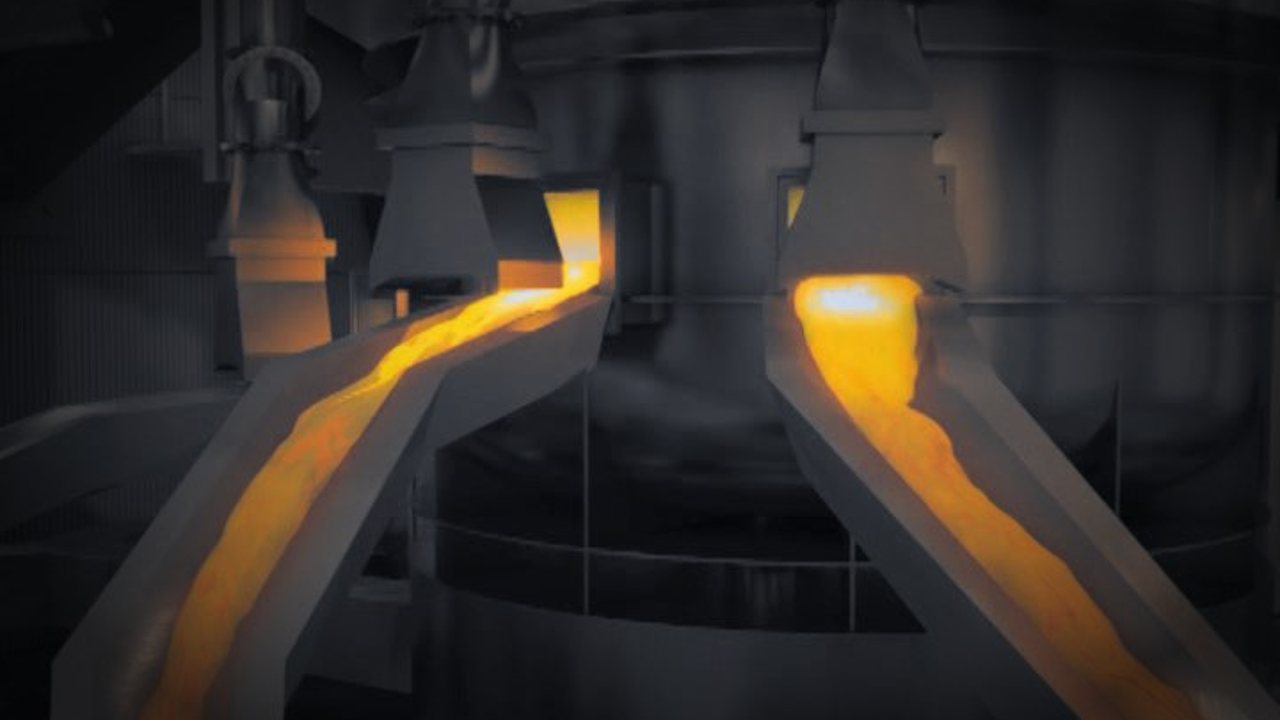
ArcSec Technologies develops and operates facilities that convert landfill-bound municipal material, biomass, and other carbon-based feedstock into a fuel gas for the gas turbines that power data centers. The conversion takes place in a graphite electric arc furnace — the same class of equipment the steel industry has operated at scale for more than a century — at temperatures that break the material down into fuel gas rather than burning it. The furnace produces no ash: metals are recovered and sold, and the remaining mineral content leaves as a glass-like aggregate used in construction.
Designed to accept mixed municipal streams, biomass, and other carbon-based material with limited front-end processing.
The feedstock is thermally converted in an oxygen-limited reactor rather than combusted. The rest melts into metal and a vitrified aggregate.
Cleaned synthesis gas, conditioned to the contracted turbine-fuel specification and delivered behind the meter.
Contracted fuel delivered to customer-owned generation on the campus schedule.
Products, not ash. Metals are recovered and sold; the mineral fraction leaves as a vitrified aggregate. Designed to minimize landfill residuals.
Two revenue sources. Parishes and haulers pay a tipping fee to deliver material, as they do today at a landfill; the data center pays for the fuel under a long-term, fixed-price contract. ArcSec supplies fuel to a campus's own generation and complements the utility service already in place.
The largest names in digital infrastructure are building here — Meta's Hyperion campus in Richland Parish alone is planned at five gigawatts — and the state has secured more than $150 billion in new investment in two years. A data center can be planned, financed, and built faster than power can be delivered to it, and the gap can run years. As the state's grid modernization continues, the largest campuses have invested in their own solar and gas turbines to hold their timelines. Every one of those turbines needs fuel, and the fuel has to be ready when the campus is.
Louisiana has welcomed innovators and backed breakthrough energy technologies for as long as it has fueled the country. ArcSec Technologies was founded here, and ArcSec Infrastructure LLC, the project company, was formed here in 2026. The addressable large-load customers are being built here, and the material to make the fuel is within reach of them.
The concerns ArcSec addresses are the state's own — reliable, affordable energy for households and industry, the burden of landfill disposal, and a fuel supply that adds to the industries the state was built on rather than displacing them. Its President, Dr. Bill Richardson, former LSU AgCenter Chancellor, has worked with the state's parishes, landfill owners, and public officials for decades, including on a post-Katrina recovery project. ArcSec operates with a premium on trust and credibility — the currency that matters most in Louisiana.
What it means for Louisiana. Every ton into the furnace is a ton that stays out of a landfill, roughly 148,500 tons a year at full operation. Longer landfill life for participating parishes, and a new revenue line for them. Construction and permanent jobs at the plant. And nothing on anyone's power bill: the project is privately financed, and the data center pays for its own fuel.
No plant capital proposed for recovery through retail electric rates.
Recovered metals and a vitrified aggregate leave the facility.
The feedstock is thermally converted in an oxygen-limited reactor rather than combusted, and its energy is retained in a fuel gas that is later used in customer-owned generation. The furnace produces no ash.
The fundamentals are established. Manufactured gas lit Louisiana's streets in the 1830s, and the electric arc furnace has been the workhorse of steelmaking since the early 1900s. ArcSec's contribution is the integration — a reactor designed to accept unsorted material at scale and produce a consistent fuel gas — engineered to a build-ready package in 2006–07 with CH2M HILL and Tenova Pyromet and refined since. The engineers who led that work, Rod Vera and Terry Moore, lead the company's engineering today; their careers in arc-furnace and thermal processing include research at Georgia Tech. The market for the fuel — a data center's own generation under long-term contract — is roughly three years old. The technology was ready before the market was.
Louisiana lights its streets with manufactured gas.
The electric arc furnace enters steelmaking.
Reactor engineered to a build-ready package with CH2M HILL and Tenova; first plant designed, in Alabama.
CH2M HILL design basis and energy balance.
Full-scale project submitted in Australia.
ArcSec Infrastructure formed.
The reactor's designers, its systems engineer, and the relationships the state runs on, at the same table.
Dr. Bill Richardson, Rod Vera, Terry Moore, Alex Ruthberg, and Chance Tidyman.
For parishes, landfill owners, data center developers, utilities, investors, and press.